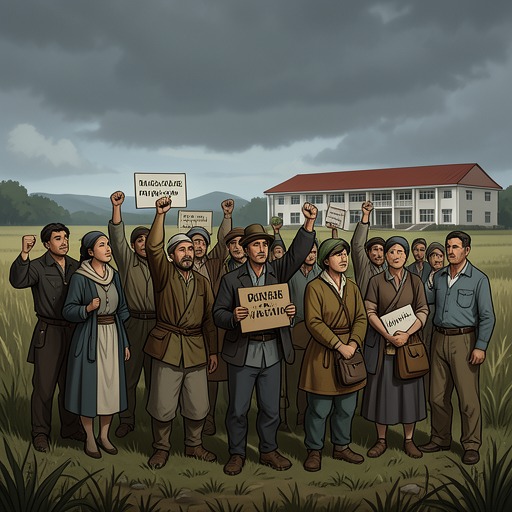
Lipce’s school-tax meeting
The PeasantsLipce’s school-tax meeting brings the village face to face with an official decision that it can debate but cannot finally control. The proposal combines a school serving several villages with a new tax and a dispute over the language of instruction. As villagers weigh the cost, Antek Boryna and Grzela call for resistance; the authorities answer with procedure, an exclusion, and a recorded vote. The result—200 votes for the school and 80 against—does not end the confrontation: the Prefect announces that the school will be established all the same.
Setting and Stakes
The meeting takes place on a hot day outside the chancellery. The Prefect has not yet arrived, and the Notary repeatedly peers down the willow-lined road. While people wait, the Voyt urges the peasants to fill the holes and dips in the square. The public setting makes the dispute visible: villagers assemble not in a private conversation but before local officials, the Notary, and, eventually, the gendarmes.
The proposal is presented as a school for Lipce and neighboring Modlica, Przyłęk, Rzepki, and smaller villages. The Notary describes the land, building, and upkeep that will be required, including a teacher’s salary, and names an additional tax of twenty kopecks per morgen. He relays the Prefect’s promise that, if the proposal is approved, construction can begin that year and children can attend the following autumn. The projected benefit therefore arrives attached to a specific continuing cost, which villagers consider while already burdened by taxation.
The quarrel is not only about whether a school is useful or affordable. Grzela insists that teaching in the village school must be in the villagers’ own tongue, and the crowd voices resentment at being ordered to use another language. The meeting thus brings the material question of who will pay into contact with the political question of who determines what children will learn and in what language.
Organizing Opposition
Before the formal vote, Antek, Mateusz, and Grzela move among separate groups of villagers, each urging them to disregard the Prefect and officials who support the school. Their styles differ: Antek speaks briefly and firmly, Mateusz uses jokes, and Grzela makes a more extended, bookish argument. Yet they press the same appeal. The crowd listens, and many appear to lean toward voting against the proposal, though fear of opposing officials remains palpable.
The meeting’s rhetoric recalls an earlier, larger mobilization over the manor’s felling of the forest. There, villagers gathered shoulder to shoulder while waiting for Boryna, then answered a speech against the manor’s treatment of them by rushing home to prepare for collective action. At the school meeting, too, a crowd’s shared grievance takes shape through public speech and a call to act together. But the form of action is different: this dispute proceeds through a commune vote, and officials remain present to manage the procedure. The comparison highlights both the village’s capacity to organize and the constraints under which it must do so.
When the Notary calls for someone to run an errand to the manor, no one moves. That refusal is small but pointed: the assembled villagers have come to decide a public question, not to serve the Notary. As the discussion grows louder, Grzela declares that they will not approve a single grosz for the school, and others join the rejection. The Voyt’s attempt to hurry the proceedings toward approval meets a more determined public response.
Antek’s Exclusion and the Language Dispute
Antek speaks up before the officials, but the Prefect asks who he is and has the Notary announce that Antoni Boryna, being under criminal investigation, has no right to participate in the commune meeting. The rule changes the scene from argument over the school to a direct test of who is permitted to take part in local decision-making. Antek flushes with anger; the Prefect orders him out, and the gendarmes are directed to remove him.
Antek does not leave quietly in spirit. He urges the men not to approve the proposal and insists that the law is on their side, then walks back toward the village while glaring at the gendarmes. The exclusion removes him from the meeting but does not erase his appeal from the crowd’s hearing. Around the gendarmes, villagers briefly close ranks, then part to let them through and surge after them with angry curses and raised fists. One of the crowd’s repeated complaints is that every creature has its own tongue, yet the peasants alone are ordered to use another’s.
That language claim gives the gathering a wider meaning than a disagreement over the tax assessment. The villagers challenge the authority to prescribe how they are to be educated, even as the official process determines who may speak and how votes will be counted. The scene stages that unequal encounter in concrete terms: the Prefect and Notary control the meeting’s rules, while the villagers try to make their collective voice count within them.
The Vote and Its Outcome
After Antek’s removal, the crowd erupts into overlapping argument. The Notary takes a roll of those present, and the Voyt eventually instructs those who support the school to move to one side and raise a hand. Some do so; many remain still. The Prefect then orders a vote by name. Each person is summoned in turn, and the Notary marks the record according to whether the vote is for or against.
The announced result is 200 votes for the school and 80 against. It is a decisive numerical majority, but it follows a meeting in which opposition to the tax and the school’s language was openly voiced, and in which some villagers had feared challenging the officials. Grzela’s supporters call for another vote, alleging that they have been cheated, and others demand that the papers be torn up. Their protest shows that recording a result does not automatically produce shared confidence in it.
At that moment, the squire’s carriage arrives. After reading a letter handed to him, the Prefect declares that there will be a school in Lipce. The gathering falls silent; the Prefect signs papers, enters the carriage, and leaves. His announcement closes the immediate proceedings without resolving the underlying conflict. The school is to be established, while the villagers’ objections—to the expense, to official power, and to instruction in another tongue—remain audible in the scene’s final contrast between their earlier clamour and their quiet as the decision is confirmed.